
Free shipping On Most Orders Over $200

The correct lug nut seat is the shape that matches the contact surface inside your aftermarket wheel's lug hole. A Subaru WRX's factory lug nuts don't automatically fit a new wheel, even if the wheel fits the car's bolt pattern.
Look closely at the wheel's lug holes and its fitment specifications before choosing hardware. The three common seat types are conical, ball or radius, and flat or shank, and they aren't interchangeable.
A lug nut clamps the wheel against the hub through its seat, the surface where the nut meets the wheel. When those two surfaces match, the hardware can make broad, even contact. When they don't, the nut may contact only along a narrow edge or ring.
That mismatch can damage the wheel's lug seat or reduce clamping force. A nut that threads onto the WRX's stud and appears to tighten isn't necessarily the right one.
The wheel's design specifications determine the required seat. They may identify it as 60-degree conical, ball seat, or mag seat, for example. The WRX's original nuts describe the car's factory setup, not every aftermarket wheel that can fit it.
Use the wheel's specified seat type, not the seat on the factory nuts, as your starting point.
A wheel can have the correct bolt pattern and still need a different lug nut seat. Bolt pattern, hub bore, offset, and seat shape are separate fitment details. Treating one as proof of another can lead to mismatched hardware.
The contact geometry is the main clue. Look at the wheel's lug hole and compare its seat to the matching area on the nut.
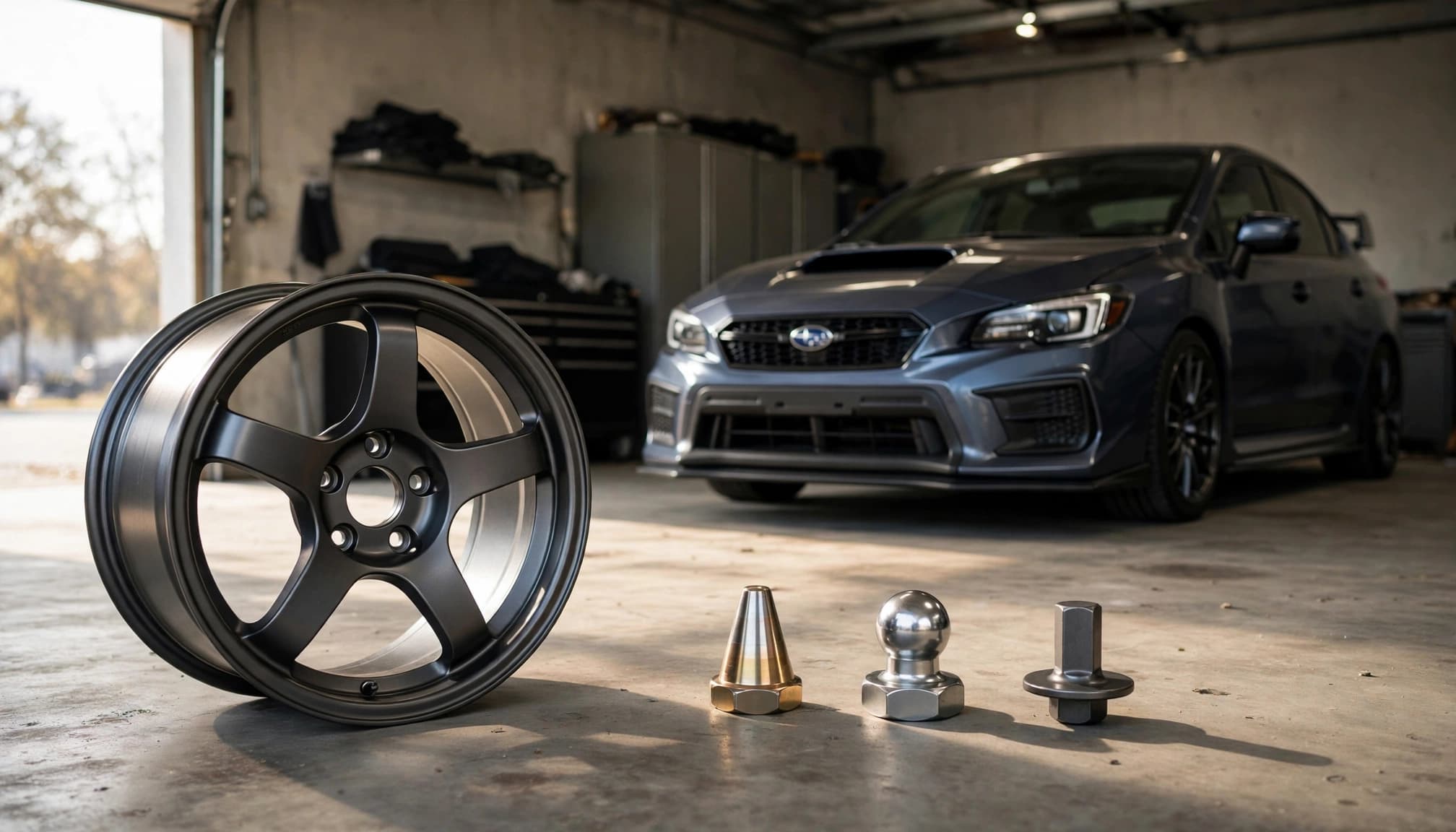
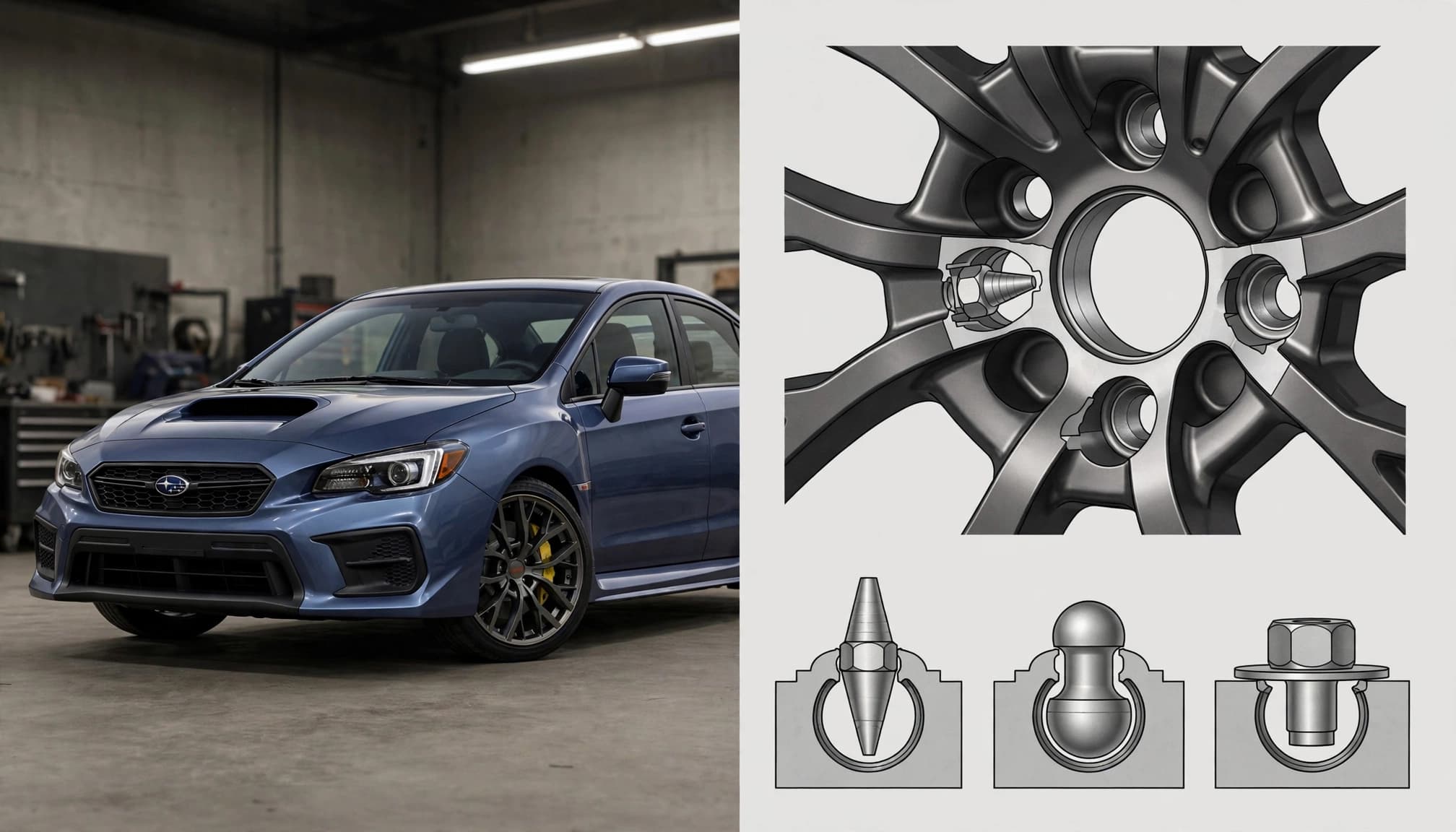
A conical seat, often called an acorn seat, narrows into a straight angled surface. A 60-degree cone is common on aftermarket wheels, although some designs use a 45-degree angle. The nut's taper must match the wheel's angle.
When viewed from the side, the contact surface looks like a straight bevel rather than a curve. Don't assume every tapered-looking hole has the same angle. The lug seat type guide distinguishes 60-degree and 45-degree conical seats.
A ball seat has a rounded, spherical contact surface. Its curve is designed to meet a matching curved seat in the wheel. Unlike a conical seat, it doesn't form a straight taper.
The radius needs to match as well as the general shape. A conical nut placed against a ball seat can touch only around a thin ring, rather than across the intended contact area.
A flat, or mag-style, seat has a flat contact surface. The lug nut commonly includes a flat washer and a straight cylindrical shank that fits into a counterbore in the wheel.
The shank's length and diameter matter. If it's too long, it can bottom out before clamping the wheel. If it's too short, it may not sit correctly in the bore. The wheel's specifications should identify the required shank arrangement.
Start with the wheel's documentation or product specification. Look for a specific seat description, such as "60-degree conical," "ball seat," or "mag seat with shank." If you have the wheel in hand, inspect the lug holes directly.
Use a light to see the shape inside each lug hole. A straight bevel points to a conical seat; a smooth, curved bowl indicates a ball seat; a flat recessed surface around a cylindrical bore suggests a shank-style setup.
The outer face of the hole can be misleading. Focus on the surface the nut is meant to contact. If the wheel is already mounted and the seat is hard to see, removing it makes inspection easier.
A wheel listing may include dimensions such as diameter, width, bolt pattern, offset, and center bore without stating the seat type. Those numbers help assess vehicle fitment, but they don't identify the lug seat.
For example, an Enkei RPF1 listing for early WRX fitment gives wheel dimensions and fitment details. Those details don't, by themselves, establish which seat a lug nut needs. Get the seat specification from the wheel's technical information.
The nut must match both the wheel seat and the stud threads. Seat shape describes the nut-to-wheel contact; thread diameter and pitch describe how the nut fits the stud. A match in one category doesn't guarantee a match in the other.
Subaru WRX applications commonly use M12 × 1.25 hardware, but stud specifications can vary with the vehicle and replacement parts. For example, Envision Tuning lists an ARP M12 × 1.25 wheel-stud kit for WRX applications. That thread size is separate from the wheel's seat profile.
A nut with the right thread can still have the wrong seat. Likewise, a correctly shaped nut won't work if its threads don't match the stud. Avoid forcing a nut onto a stud; it should start smoothly by hand.
Aftermarket wheels may have narrow lug openings or recessed pockets. The nut's outside diameter and the socket needed to install it must fit without scraping the wheel. Spline-drive or slim-body nuts can address access constraints, but their seat and thread still need to match.
Open-ended nuts can accommodate extended studs when the hardware is designed for that use. Closed-ended nuts need enough internal depth to avoid contacting the end of the stud before clamping the wheel.
Choosing the correct seat is one part of installing an aftermarket wheel. The wheel also needs to fit the WRX's hub and clear the brakes and suspension.
Bolt pattern, center bore, offset, wheel width, and brake clearance all affect fitment. None of these dimensions tells you whether the wheel has a conical, ball, or flat seat.
For instance, a wheel can have the right bolt pattern but an incompatible center bore. A wheel can also clear the fender while contacting a brake caliper. Evaluate these details independently, then match lug hardware to the wheel's seat specification.
Before driving, make sure each nut threads freely and the correct portion of its seat contacts the wheel. For shank-style hardware, the shank should enter the wheel's bore without binding or bottoming out. The nut must clamp the wheel before it runs out of thread or reaches the end of the stud.
If the wheel's seat type or the required hardware isn't clear, pause the installation. A qualified wheel or tire technician can identify the seat and check the assembled fitment.
Once the wheel and hardware match, install the nuts carefully. Start each one by hand to reduce the chance of cross-threading. Then snug them gradually in a star pattern so the wheel seats evenly against the hub.
Use a torque wrench and the torque specification that applies to the vehicle and wheel hardware. Subaru's vehicle resources page provides access to owner information and manuals. Follow the instructions that apply to the specific installation rather than treating one torque figure as universal.
Keep threads and seats in the condition specified by the hardware maker. Lubricant changes clamping force at a given torque, so don't add it unless the instructions call for it. An impact wrench can run nuts down, but it shouldn't replace final tightening with a torque wrench.
After tightening, inspect that the wheel sits flush against the hub and that every nut has seated evenly. If a nut feels rough, stops early, or leaves a visible gap, remove it and find the cause instead of tightening harder.
Follow the wheel or hardware maker's instructions for any post-installation torque check. Don't drive on a wheel that isn't fully seated or has a questionable nut-to-wheel contact.
Only if the aftermarket wheel specifies a seat that matches those nuts, and the threads and nut dimensions also fit. The vehicle model alone doesn't establish compatibility.
No. A conical nut has a straight angled surface, while a ball-seat nut has a curve. Their contact geometry differs, so use the shape specified for the wheel.
No. The bolt pattern describes the layout of the mounting holes. It doesn't specify the shape of the contact surface inside each lug hole.
The right lug nut seat is the one designed for the aftermarket wheel, not simply the one supplied with the WRX. Identify the wheel's seat shape, match the nut's threads and dimensions, then install the assembly using the applicable torque procedure.