
Free shipping On Most Orders Over $200

For the FK8 Civic Type R, the ADVAN Racing TC-4 offers a bold five-spoke look, while the RZIII uses a more detailed twin-five-spoke design. Neither is an automatic performance winner, because wheel specification and tire choice matter more than spoke count.
The useful Advan TC4 vs RZIII comparison starts with the FK8's factory dimensions, Brembo brakes, and intended use. Once those requirements are clear, choosing between the two becomes much easier.
For either wheel, an 18-inch setup deserves consideration if you want more tire sidewall than the factory 20-inch package. However, wheel diameter alone doesn't determine fitment, comfort, or performance.
The FK8 already has prominent bodywork, large vents, and a substantial rear wing. These two wheel designs complement that shape in different ways.
Yokohama describes the TC-4 as a full-face five-spoke design. Its long spokes extend toward the rim, so the wheel looks visually substantial without a dense spoke pattern.
On an FK8, that open layout leaves the red front calipers visible. It also provides relatively accessible spaces for cleaning brake dust.
The TC-4 suits an owner who wants the wheels to give the car a simpler, more purposeful appearance. However, its concavity depends on the specification. A photograph of one TC-4 size doesn't establish how another width and offset will look.
The RZIII is the third generation of ADVAN's RZ series. Its twin-five-spoke layout creates ten spokes arranged as five pairs.
That additional detail works well with the FK8's angular bodywork. Compared with the TC-4, the RZIII gives the wheel face a busier appearance without covering the brakes completely.
For owners who like a more elaborate spoke pattern, that's the main attraction. The narrower spaces between paired spokes also mean more surfaces to clean.
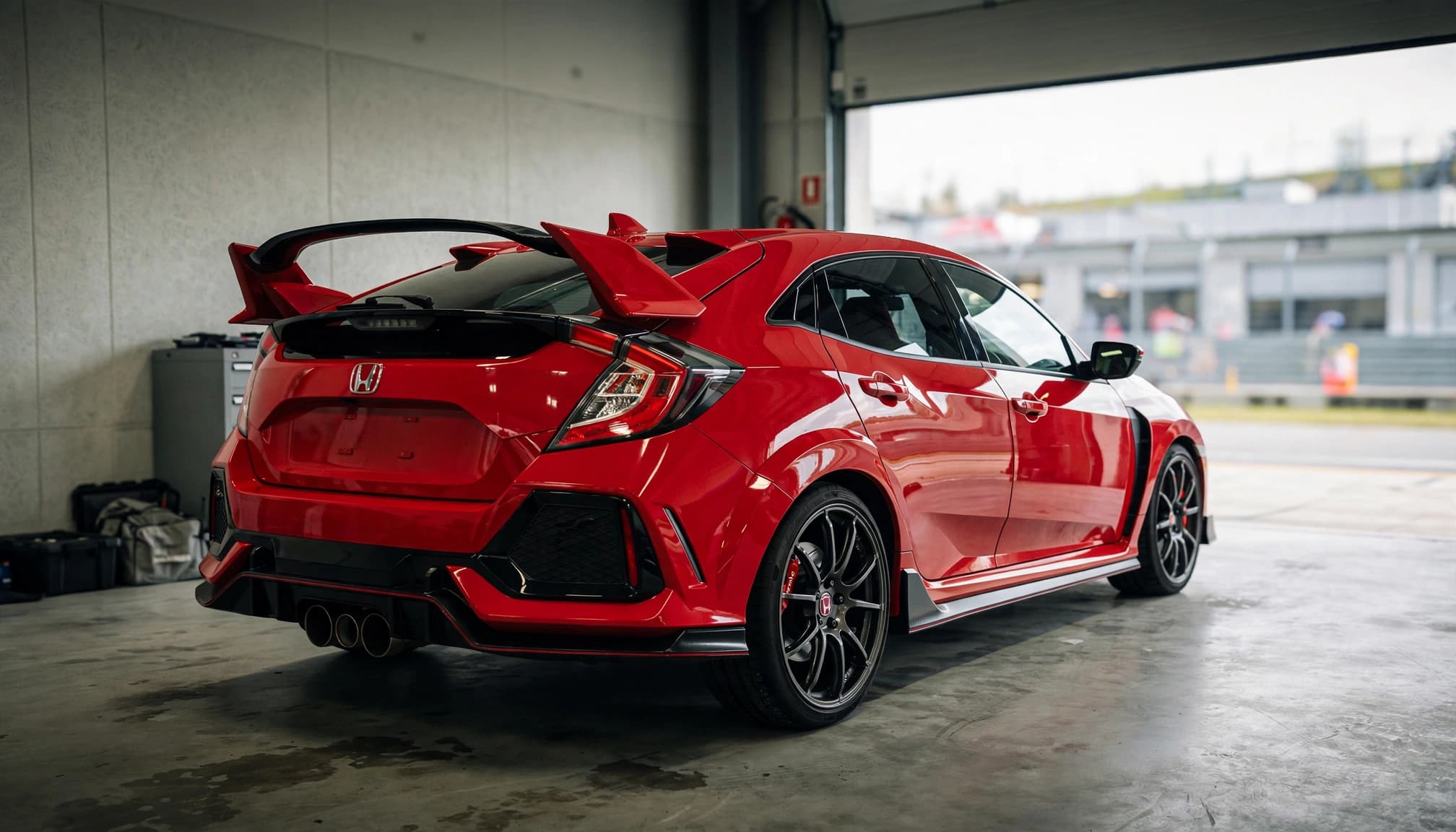
The standard U.S.-market FK8 wheel package is 20x8.5 inches, +60 offset, with a 5x120 bolt pattern and 245/30R20 tires. Keep that baseline in mind when comparing aftermarket dimensions.
Published TC-4 configurations relevant to this discussion include 18x9 +53, 18x9.5 +45, and 18x9.5 +38 in 5x120.
Those specifications have different priorities. The 18x9 +53 makes a smaller change to wheel position than either 9.5-inch option. Meanwhile, the +38 version moves farther outward than the +45 version.
At an identical 9.5-inch width, changing +45 to +38 moves the entire wheel outward by 7 mm. That adds inner clearance but consumes the same amount of outer clearance.
Yokohama's TC-4 face-design information identifies Standard, GTR, and Super GTR faces for the 18-inch range. These aren't interchangeable appearance options across every specification.
Published RZIII specifications include an 18x9.5 +45 wheel in 5x120. That gives FK8 owners a useful comparison with a TC-4 carrying those same dimensions.
At equal width and offset, both wheels place their rim edges in the same nominal positions. Their spoke profiles and internal shapes can still differ.
Compared with the factory wheel, an 18x9.5 +45 places its outer rim approximately 27.7 mm farther outward. That calculation excludes tire bulge, so it doesn't establish fender clearance.
Bolt pattern is only one part of wheel fitment. The FK8 also needs suitable hub fit, mounting hardware, and clearance around its front brakes.
The FK8 uses a 64.1 mm hub bore and M14x1.5 wheel-nut threads. An aftermarket wheel with a larger center bore needs the appropriate hub-centric ring.
For a 72.5 mm-bore wheel, that means a 72.5-to-64.1 mm ring. Match the ring to the actual wheel bore rather than assuming every ADVAN application uses the same dimension.
Wheel-nut seat shape matters too. The factory Honda nuts use a ball seat, while these aftermarket applications require suitable tapered-seat hardware. The correct thread doesn't make an incompatible seat safe.
Stud engagement also matters, particularly when spacers enter the setup. A thicker mounting stack reduces the thread available to secure the wheel.
The FK8 has four-piston Brembo front calipers and 350 mm front rotors. An 18-inch wheel therefore needs adequate barrel clearance and a spoke profile that clears the caliper body.
Width and offset don't describe those shapes completely. A more concave-looking face also doesn't automatically provide more caliper clearance.
A wheel can share another wheel's diameter, width, and offset while having a different spoke-to-caliper relationship.
For an FK8 with larger aftermarket brakes, the wheel decision must account for that brake package. Factory-brake dimensions no longer describe the entire clearance requirement.
An 18-inch conversion needs a tire selected around its intended wheel width, overall diameter, and available space. Simply adding sidewall isn't enough.
The factory 245/30R20 tire has a calculated nominal diameter of 655 mm. By comparison, a 245/40R18 calculates to 653.2 mm, almost identical overall.
That size illustrates why downsizing the wheel doesn't require a much smaller tire assembly. Its nominal sidewall increases from 73.5 mm to 98 mm, while overall diameter stays close to stock.
A 255/35R18 calculates to 635.7 mm, approximately 3% smaller than the factory tire. That difference affects gearing, indicated speed, and ground clearance.
These calculations describe nominal dimensions. Tire construction and tread design also affect actual dimensions, so equal sidewall markings don't make every tire physically identical.
Wheel width determines which tire sizes are suitable, but tire section width also affects suspension and fender clearance. A wider wheel doesn't automatically justify the widest tire available.
For street use, prioritize a tire approved for the chosen rim width, with adequate load capacity and a diameter appropriate to your goals. Extra width has limited value if the tire contacts the body during compression.
Track use adds sustained cornering loads and greater suspension movement. Lowering, alignment, and tire shoulder shape all affect the available room.
Choose the wheel and tire as a package. Buying the most aggressive offset first can unnecessarily restrict your tire options later.
Both designs can belong on a street-driven or performance-focused FK8. The useful distinction is how the complete setup supports your driving.
An 18-inch package with an appropriately sized tire offers more sidewall than the factory 20-inch arrangement. That additional sidewall can improve impact tolerance, although tire construction and pressure still influence ride quality.
For a daily driver, a less aggressive wheel position leaves more room for tire movement. It also reduces the pressure to use additional negative camber purely for body clearance.
The TC-4's open face makes routine cleaning simpler. The RZIII adds visual detail, so choose it if that appearance matters more than the extra cleaning effort.
For performance use, focus on tire support, clearance through suspension travel, and the complete assembly's weight. Spoke count alone doesn't tell you which wheel will deliver a quicker lap.
An aggressive offset changes more than appearance. Moving the tire outward also changes its relationship to the steering axis, which can affect steering feedback.
A square setup, with matching front and rear wheel and tire specifications, can simplify rotation and tire management. However, it still needs sufficient clearance at both axles.
If you're coordinating wheel changes with brakes or suspension, our FK8 performance parts collection brings those upgrades together. Treat them as one vehicle setup rather than unrelated purchases.
Start with the tire size and the space your FK8 provides. Then choose a wheel width and offset that support that tire without relying on unnecessary spacers or excessive alignment changes.
For owners comparing two 18x9.5 +45 configurations, appearance becomes a cleaner deciding factor because the nominal rim positions match. The TC-4 offers five bold spokes; the RZIII offers five pairs.
The comparison changes when the specifications differ. A TC-4 in +38 shouldn't be judged against an RZIII in +45 as though spoke styling is the only difference.
Also separate finish preference from fitment. A particular color or deeper face can be appealing, but neither compensates for insufficient tire clearance.
We'd prioritize usable clearance over maximum outward position, especially on an FK8 that handles commuting, rough roads, and occasional performance driving. A slightly more restrained setup is often easier to live with throughout the car's suspension travel.
Yes. Matching wheel and tire specifications front and rear allow front-to-rear rotation, provided the tire's directional requirements are respected.
That can be useful on a front-wheel-drive FK8 because the front tires handle acceleration, steering, and much of the braking load. However, rotation can't correct an alignment problem or repair unevenly damaged tires.
Yokohama's 18-inch RZIII launch announcement gives October 24, 2025, as its Japanese release date.
That date applies to the announced 18-inch product launch. It doesn't establish stock availability for every finish, width, offset, or market. The RZIII name identifies the design family, while the individual specification determines its suitability for a particular setup.
The TC-4 is the straightforward choice for a bold five-spoke appearance. The RZIII suits owners who prefer a more detailed twin-five-spoke face.
For your FK8, fitment comes first. Set the tire, wheel position, brake clearance, and mounting requirements before choosing the finish. Once those requirements are satisfied, either design can complement the car without asking appearance to compensate for the wrong specification.