
Free shipping On Most Orders Over $200

For a street-driven 2017-2021 Honda Civic Type R, choose pads that deliver reliable cold response, predictable pedal feel, and tolerable noise. The right Civic Type R brake pads also need to match the FK8's front or rear calipers.
A race-focused compound can add compromises your commute doesn't need. Meanwhile, a low-dust pad may suit you better than one with stronger initial bite.
Start with axle-specific fitment, then narrow your choice around the stops you make every day.
The FK8's front and rear brakes use different calipers, pad shapes, and rotor designs. A front set isn't interchangeable with a rear set, even when both listings say "Civic Type R."
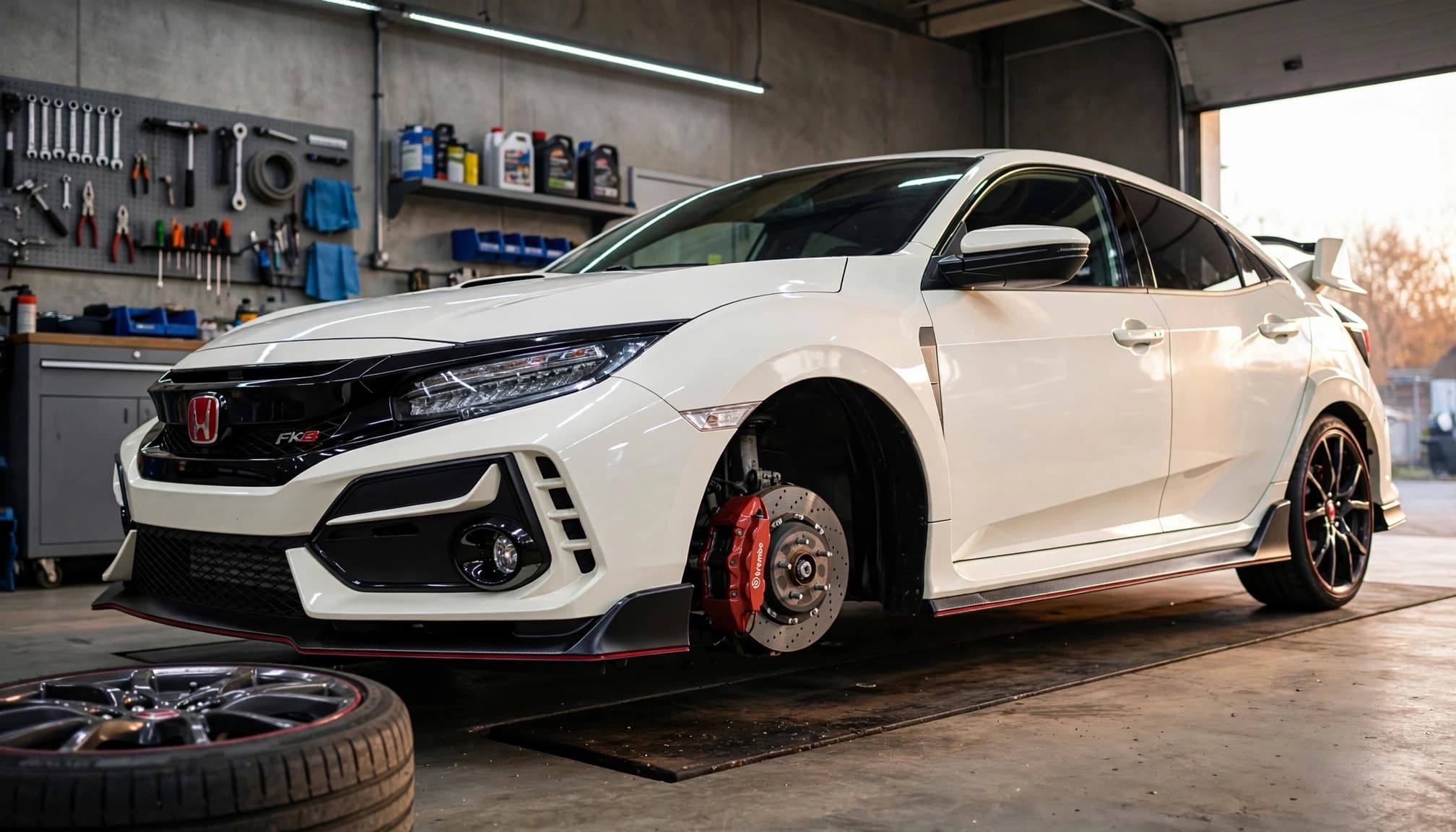
The factory front brakes use four-piston Brembo calipers and 350 x 32 mm ventilated rotors. The community-maintained FK8 brake hardware reference documents this setup.
Some front-pad listings also name Subaru STI and Mitsubishi Evo applications because certain pad shapes overlap. That shared listing doesn't make every STI or Evo pad suitable. The application must include the FK8's factory Brembo caliper.
If your car has an aftermarket big-brake kit, its caliper determines pad fitment instead of the original Honda application.
The rear brakes use single-piston calipers, solid rotors, and an electronic parking brake. They require their own pad shape and service procedure.
Our FK8 brake parts collection separates several front and rear options. For factory hardware, your selection needs to identify the 2017-2021 Type R and the correct axle. A generic Civic, Civic Si, or FL5-only listing isn't enough.
Also distinguish an axle set from a complete front-and-rear package. One product price doesn't automatically cover all four wheels.
A street pad spends much of its life below track temperatures. Its behavior during a cold morning stop matters more than a headline maximum-temperature rating.
Cold bite describes how readily a pad generates braking force before it heats up. However, stronger initial bite doesn't automatically mean better control.
Modulation matters too: braking force should build predictably as you press harder. That makes parking maneuvers and wet-weather driving easier to manage. An abrupt compound can feel impressive initially but become tiring in traffic.
For everyday use, favor a street compound with useful friction at ambient temperatures. Don't assume a pad needs warming up simply because the car is performance-oriented.
Also, a more aggressive compound doesn't guarantee a shorter single emergency stop. Tire grip, road conditions, and ABS affect that result.
Low dust and low noise are separate characteristics. A pad can keep wheels cleaner yet still squeal under light pressure.
Ceramic street formulations often target reduced visible dust and comfortable operation. However, the word "ceramic" alone doesn't establish cold bite, heat tolerance, or noise levels.
Installation also affects sound. Worn hardware, uneven rotor surfaces, contamination, or unsuitable lubrication can make an otherwise street-friendly pad noisy.
A low-dust compound changes how much wheel cleaning you face. It doesn't eliminate the need for healthy rotors and correctly serviced calipers.
Compare compounds within the axle you need. Front-pad prices and rear-pad prices aren't directly comparable, and a higher price doesn't establish a better daily-driving match.
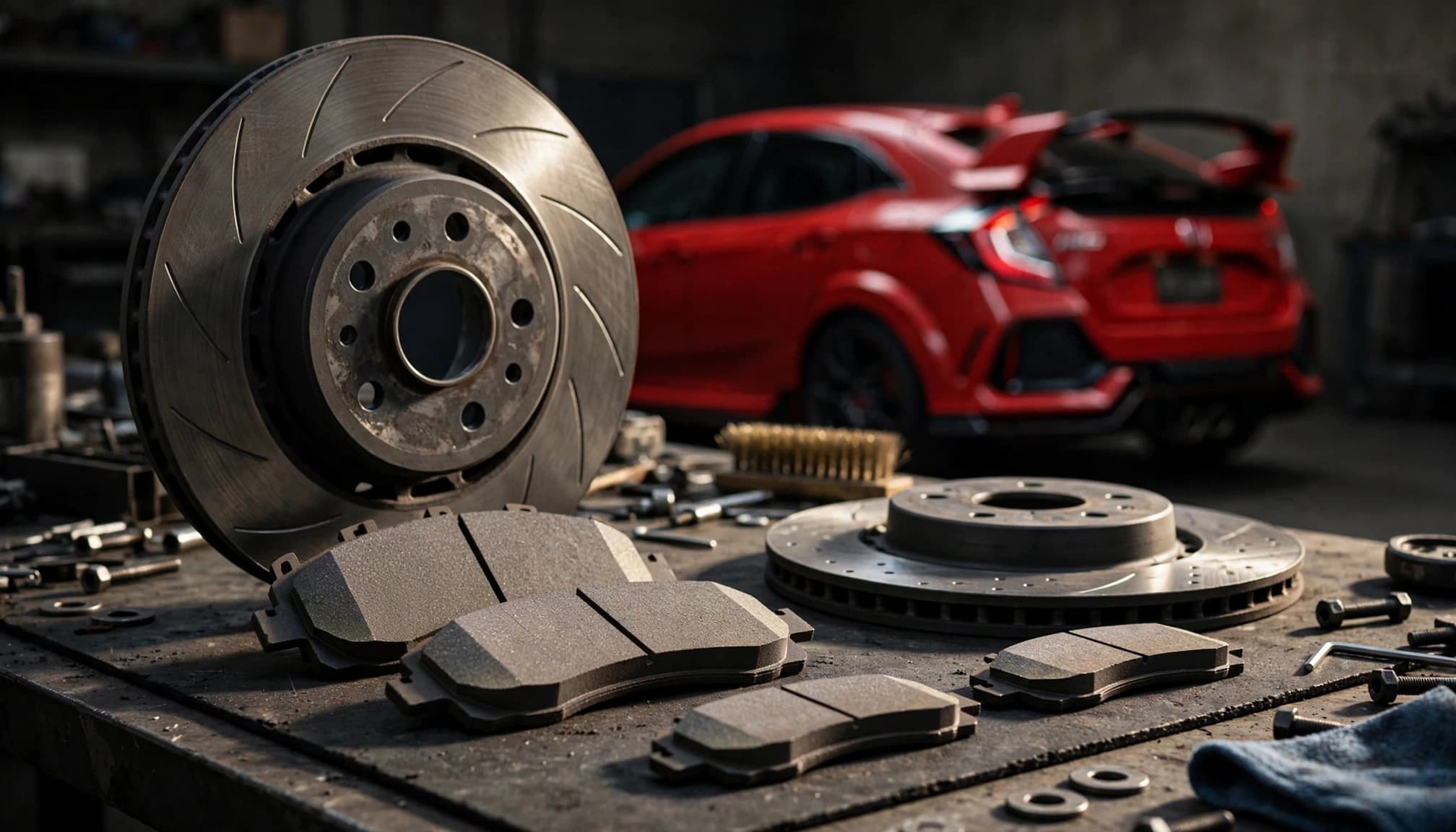
Hawk Performance Ceramic front pads are an everyday-driving option, listed at $193.49. They belong on the shortlist when daily manners matter more than choosing the most aggressive compound.
For the rear, EBC Redstuff brake pads target reduced dust and useful cold response. Our listing is $150.53 and marked sold out.
EBC also notes that full bedding can take up to 1,000 miles. Initial installation therefore doesn't mean the pads have finished conforming to the rotor surface.
Project Mu TYPE NS rear pads are another named FK8 option at $142.10. However, that lower price alone doesn't establish a noise or dust advantage.
Hawk HPS 5.0 front pads are listed at $188.09. Hawk positions them as performance street pads, with hot-and-cold friction, low noise, and rotor-friendly behavior among its stated characteristics.
The front listing uses part number HB453B.585, which distinguishes it from Hawk HPS Composite HB453F.585 at $179.09. These are separate compounds.
Project Mu HC+ rear pads are listed at $234.60. Their low-metallic formulation targets response and fade resistance for spirited driving. Choose them for those priorities, rather than assuming they'll be quieter or cleaner than a comfort-oriented pad.
Street pads need to work during ordinary driving without a warm-up routine. Track-focused compounds prioritize sustained high-temperature braking and may bring more noise, dust, or rotor wear.
The exact compromises depend on the formulation. Some competition compounds also deliver less useful friction when cold, so a racing label shouldn't automatically move a pad up your street shortlist.
Project Mu CLUB RACER rear pads, listed at $219.70, belong in a different discussion from comfort-oriented daily replacements. Their lower price than HC+ doesn't make them the better commuter purchase.
Likewise, EBC describes Yellowstuff as having strong cold response but makes clear that it isn't a low-dust option. That distinction matters if clean wheels are your main reason for replacing the factory pads.
For a car that also attends track events, street-pad selection and track preparation need separate decisions. Don't stretch a street recommendation into a claim about repeated track sessions.
Finally, avoid choosing dramatically different front and rear friction characteristics without an established pairing. Changes in friction can alter brake balance.
Street compounds designed for the FK8's original iron braking surfaces don't require drilled or slotted rotors simply because they're aftermarket pads. Rotor condition and correct sizing matter more than surface styling.
The 2017-2019 FK8 uses a different factory front-rotor construction from the 2020-2021 model. The earlier setup has drilled front rotors; the later car uses a two-piece design. Both retain the 350 x 32 mm front dimensions.
That shared size doesn't make every replacement rotor identical. A rotor purchase still needs the correct year and installed hardware application.
At the rear, our EBC USR slotted rotors are one FK8 replacement option. Slots aren't a requirement for a street-pad change, and they don't correct a worn-out braking surface.
New pads won't repair deeply scored, cracked, or undersized rotors. A technician should assess rotor condition, caliper movement, and pad wear across both sides of each axle.
Persistent screeching also deserves inspection. Honda's brake-wear guidance identifies that sound during braking as a possible sign that pads need replacement.
Replace pads as complete axle sets. Then use the chosen compound's bedding procedure, including any rotor-preparation requirements. Don't combine unrelated bedding instructions.
Because the rear system includes an electronic parking brake, leave rear-pad service to a qualified technician if you're unfamiliar with its retraction procedure.
Brand matching alone doesn't guarantee a balanced setup. The compounds' friction characteristics and intended use matter more. A matched street family is a straightforward starting point, although replacing one worn axle doesn't automatically require replacing healthy pads at the other end.
No. Dust output doesn't provide a direct measurement of braking friction. Some street formulations combine reduced visible dust with useful cold response. However, changing compounds can change pedal feel, so compare the exact product's intended use instead of treating every ceramic pad as equivalent.
Include the axle set, installation, and any required rotor or hardware work. For context, our listed Hawk HPS 5.0 front pads cost $188.09 before those additional items. A pad-only price isn't a complete brake-service estimate, especially when existing rotors need replacement.
A soft or sinking pedal needs diagnosis rather than a compound upgrade. Air, fluid problems, or a hydraulic fault can affect pedal behavior. Have a qualified technician inspect the system before treating different pads as the solution.
The strongest street choice starts with correct FK8 fitment and predictable cold braking. Then weigh cleaner wheels and quieter operation against the response you want.
For a daily-driven Type R, a suitable street compound and healthy rotors make more sense than choosing by racing labels. Buy for your actual driving, and treat installation as part of the braking system.