
Free shipping On Most Orders Over $200

To choose hub-centric rings, match the ring's inner diameter to your vehicle's hub pilot and its outer diameter to the aftermarket wheel's center bore. Both measurements matter because the ring fills the space between those two surfaces.
A ring can help center a wheel during installation, but it won't correct an incompatible bolt pattern or replace the right lug hardware. Here's how to find the dimensions you need and fit the rings.
A hub-centric ring fills the gap between a wheel's center opening and the raised hub pilot on the vehicle. This helps center the wheel as you install it.
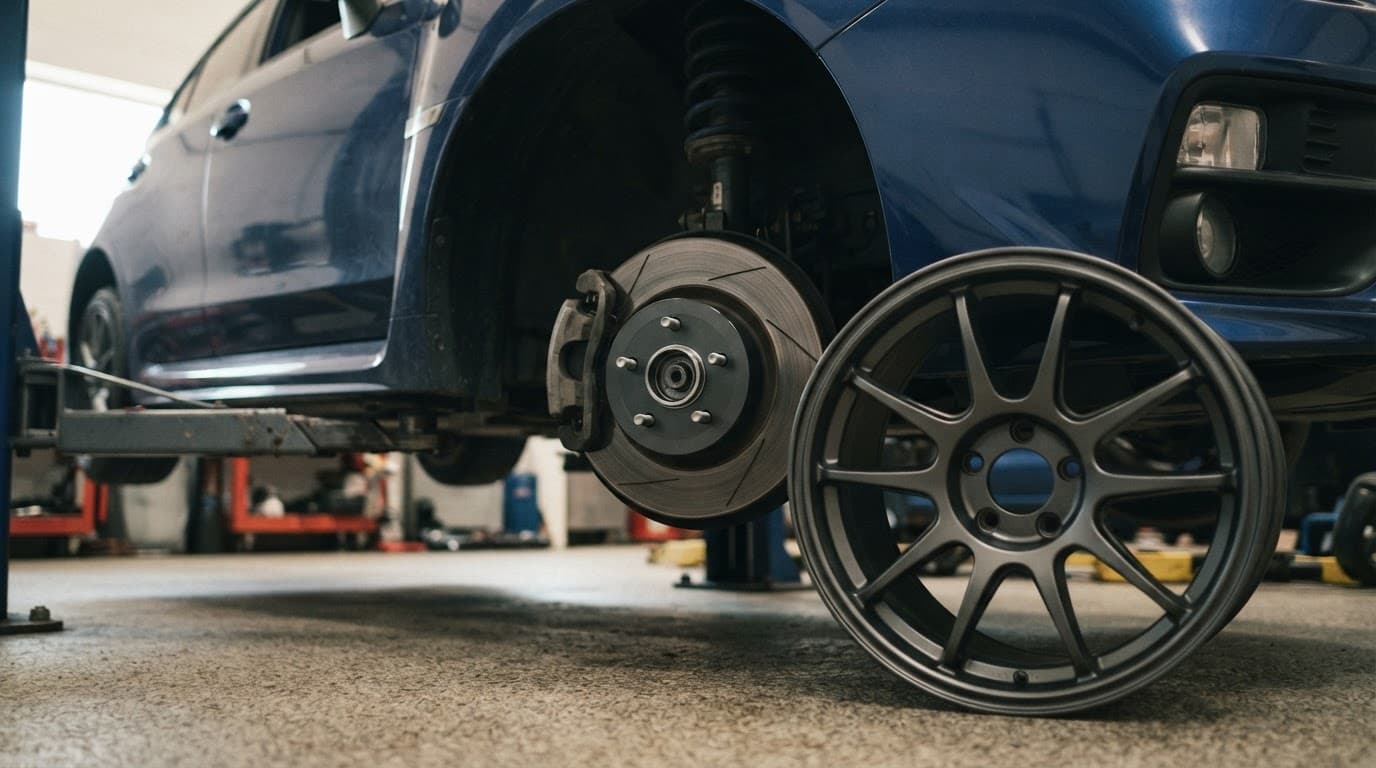
The hub pilot is the raised circular surface at the center of the vehicle's wheel mounting area. The center bore is the hole in the middle of the wheel that fits over it.
When those diameters match, the wheel can center on the hub without a ring. When the wheel bore is larger, a correctly sized ring fills the difference. For a closer look at the terminology, see this explanation of center bore and hub bore.
The ring helps position the wheel; the properly tightened fasteners clamp the wheel to its mounting surface. You still need the correct lug nuts or bolts, the right seat shape and the specified torque.
Some wheels are designed to center using their fasteners instead. Follow the wheel's intended mounting design rather than assuming every wheel needs a ring.
Ring sizes are usually listed in millimeters with two numbers. The larger number is the outer diameter, and the smaller number is the inner diameter. Product listings may present them differently, so look for the OD and ID labels rather than relying on the order alone.
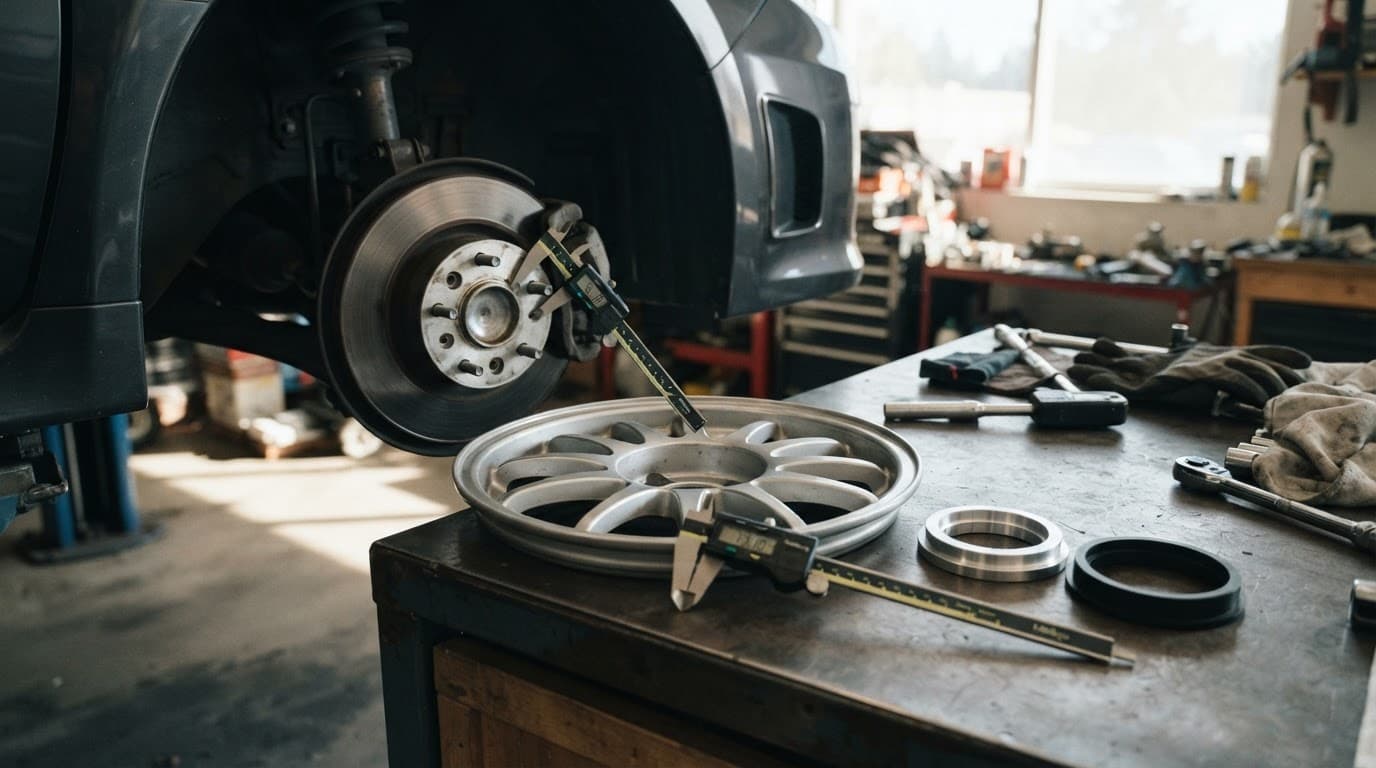
Use a digital caliper to measure the outside diameter of the raised hub pilot where the ring will sit. Remove loose rust and debris first. Buildup can give you a misleading measurement or prevent the ring from seating.
Measure across the pilot at more than one point. A damaged or heavily corroded surface may need attention before you can get a reliable reading.
Your car's make alone isn't enough to identify the size. Model year, trim and replacement hub parts can affect fitment, so use the dimensions of the parts on your car.
Measure the inside diameter of the wheel's center bore at the mounting face. The wheel specification can also give you this number.
For example, the WedsSport SA-01R is listed in an 18x8.5J, 5x100 configuration with a 65 mm center bore. An 18x9.5J, 5x114 configuration is listed with a 73 mm bore. The two configurations need different ring outer diameters, even though they're the same wheel model.
The matching inner diameter depends on the hub under that wheel. A 73 mm bore tells you the ring's OD; it doesn't tell you its ID.
Compare the two measured diameters before shopping. There are three possible outcomes:
Also consider any replacement parts already on the car. The ISR Performance dual-drilled rear hub for the BMW E36, for example, has both 5x120 and 5x114.3 bolt patterns. That flexibility doesn't establish its hub diameter. The ring still has to match the actual hub and wheel.
A center cap is a separate part, too. It covers the wheel's center opening; it doesn't take the place of a ring at the mounting interface.
Hub-centric rings commonly come in aluminum or polymer. Whichever material you choose, buy a ring made for wheel centering with the exact OD and ID your setup requires.
Start with the dimensions, then look at the ring's construction and condition. A new ring should have clean, even surfaces without cracks, distortion or rough edges that interfere with installation.
Avoid choosing by color alone. Two rings can look similar but have different diameters, and a small difference can leave the wheel loose on the hub or prevent the ring from seating.
Some rings have a lip or a chamfer to match the wheel and hub. The ring must fit the shape of both parts without holding the wheel away from its mounting surface.
Don't stack rings or modify one to make it fit. If the ring catches, rocks or leaves a visible gap behind the wheel, remove it and identify the interference before proceeding.
A ring that fits the hub but prevents the wheel from sitting flush is the wrong fit for that assembly.
A ring addresses the center opening. The rest of the wheel still has to fit the vehicle.
Match the wheel's bolt pattern to the hub, along with the fastener thread, length and seat type. Conical, ball and flat seats are different shapes; a fastener that threads on isn't necessarily the correct one for the wheel.
Check that the fasteners engage properly without bottoming out or contacting components behind the hub. A wheel shop can assess engagement if you can't determine it safely.
The wheel also needs adequate brake clearance and suitable width and offset. Test-fit it without forcing it against the caliper or suspension.
A spacer is different from a centering ring: it moves the wheel outward. Our H&R Trak+ Civic Type R spacers are an example of a hub-centric spacer design. If a spacer is part of your setup, the wheel must center on the spacer's wheel-facing pilot, and the hardware must suit the complete assembly.
Work on a level surface and support the vehicle securely with equipment rated for it. If you're unsure about lifting the car or fitting the wheels, have a qualified shop do the installation.
Torque values aren't interchangeable between cars. For instance, Nissan's 2025 Juke Hybrid installation instructions specify 113 N-m, or 83 ft-lb, for that model. That figure isn't a general setting for aftermarket wheels.
A vibration after a wheel installation deserves attention, but a missing or incorrectly sized ring is only one possible cause. Tire balance, a damaged wheel, debris on a mounting face or incorrect hardware can also be involved.
If the vibration starts after installation, avoid continuing to drive while you investigate. A shop can inspect the wheel mounting, ring fit and fastener torque, then assess the tire and wheel assembly.
When removing a wheel, look for the ring on both the hub and inside the wheel bore. It can remain in either location, and a ring left in the wheel should not be paired with another ring on the hub.
For a four-wheel setup where all four wheels have an oversized bore and use rings, you'll generally need one ring per wheel. Different front and rear hubs or wheels can require different sizes.
You can reuse a ring only if its inner diameter matches the hub, its outer diameter matches the new wheel bore, and its shape seats correctly. Replace a ring that's cracked, distorted or otherwise damaged.
No. Rings center the wheel at the hub opening; they don't change the position of the lug holes. The wheel and hub must have compatible bolt patterns.
A properly fitted centering ring fills the radial gap at the center bore. It shouldn't sit between the wheel and mounting face or move the wheel outward.
The right ring is defined by two measurements: the wheel's center bore and the vehicle's hub pilot. Match the OD to the wheel and the ID to the hub, then make sure the wheel seats flat.
Take the same care with the hardware and torque. Together, those details give your aftermarket wheels the mounting fit they need.