
Free shipping On Most Orders Over $200

Aftermarket wheels usually vibrate on a BMW E46 because of imbalance, wheel or tire runout, or incorrect mounting. A mismatched center bore, poorly fitted spacer, wrong wheel bolts, or corrosion between mounting faces can also prevent the assembly from running true.
The useful distinction is when the vibration happens. Shaking that follows road speed calls for different checks than shaking felt mainly under braking.
Start with the symptom, then inspect the installation before buying replacement parts.
If the shaking is severe, starts suddenly, or comes with loose hardware, stop driving. Have the car inspected before another road test.
A shake that appears within a repeatable speed range puts wheel balance, tire condition, and mounting accuracy near the top of the list. Note whether it continues while cruising without braking.
Steering-wheel vibration often directs attention toward the front axle. Movement through the seat or floor can suggest the rear, but vibration travels through the chassis, so location alone isn't proof.
Also note whether the problem began immediately after installation, after a pothole strike, or after the wheels came off for other work. That timeline helps prioritize the checks.
If the car cruises smoothly but shakes when you apply the brakes, investigate the brakes and suspension. Disc thickness variation, uneven friction at the rotor surface, or worn suspension components can produce this pattern.
A brake-disc thickness variation bulletin explains how lateral runout can lead to thickness variation. However, a runout reading alone doesn't establish the cause of brake judder.
On an E46, front control-arm bushings and ball joints also deserve inspection when braking triggers steering shake. Replacing wheels won't repair existing movement in those parts.
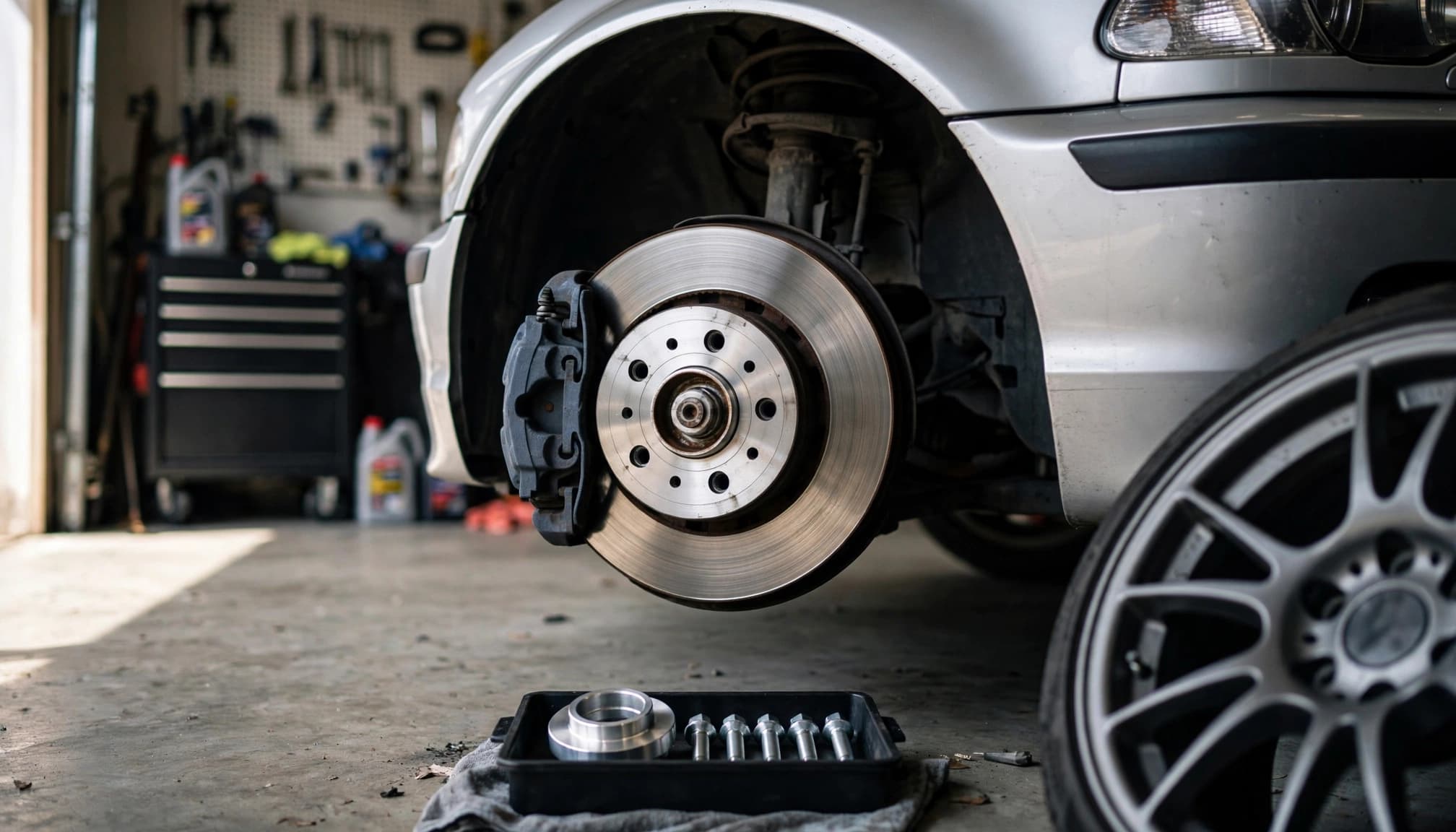
The center bore is the opening behind the wheel's center cap. The hub pilot is the raised circular section that locates the wheel.
When the wheel bore is larger, a correctly sized hub-centric ring fills that gap if the wheel's mounting design calls for one. Our guide to choosing hub-centric rings explains how the ring's inner and outer diameters relate to those surfaces.
A loose, damaged, or incorrectly sized ring can interfere with centering. During removal, inspect both the wheel bore and hub because a ring can remain stuck in either location. Never install a second ring over one already present.
Rust flakes, trapped dirt, and debris can keep the wheel from sitting flat against the rotor hat. The same problem can occur between the hub and rotor or across spacer interfaces.
Inspect the full contact area, not just the visible outer edge. Raised corrosion around the hub pilot can also stop a ring or wheel from seating completely.
A technician should clean the mating faces without grinding away base metal. If the wheel rocks against its mounting face or needs bolt force to pull it flat, stop installation and find the obstruction.
A spacer adds another mounting interface, so both sides need attention. Its inner bore must fit the hub, while the wheel-facing pilot must suit the wheel or its intended centering ring.
Also inspect the hub lip, spacer recess, and wheel-bore chamfer. Incompatible shapes can interfere before the flat faces touch, even when the advertised diameters appear compatible.
A thin spacer can reduce the hub pilot available to center the wheel. A hub-centric spacer needs enough internal clearance to seat properly. Stacking spacers adds interfaces and complicates diagnosis, so remove unnecessary pieces when investigating vibration.
Wheel bolts need the right thread, seat shape, and working length. Conical, ball, and flat seats aren't interchangeable simply because the bolt threads into the hub.
For reference, the BMW Style 45 wheel specifications list a 72.6 mm bore and M12x1.5 bolts. Those factory-wheel details don't establish the seat shape or bolt length required by an aftermarket wheel and spacer combination.
A bolt that's too short provides insufficient thread engagement. An excessively long bolt can bottom out or contact components behind the hub. Either condition needs correction before driving.
Our BMW 5x120 wheel guide covers bolt-pattern basics, but the pattern is only one part of wheel compatibility.
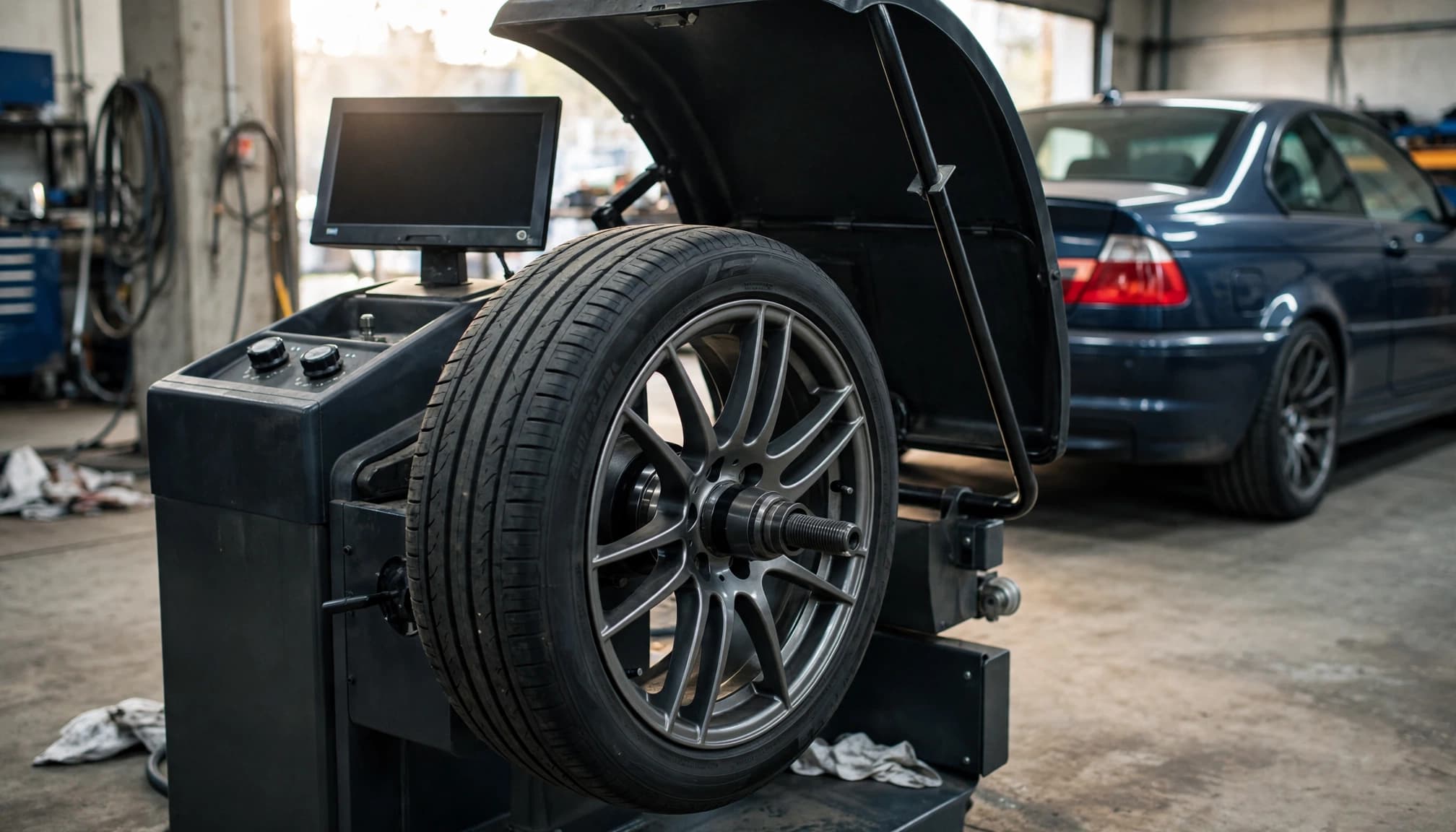
A wheel and tire assembly can have uneven mass around its circumference or across its width. Balance weights compensate for that distribution.
Missing adhesive weights, an incomplete balance, or incorrect centering on the balancing machine can leave a vibration after installation. Request a two-plane dynamic balance on suitable equipment, such as Hunter wheel balancers, with the correct mounting adapters.
If repeated balancing produces different results, the shop should inspect how the assembly mounts on the machine. Adding more weights without finding the inconsistency can leave the original problem unresolved.
Radial runout is an up-and-down variation as the assembly turns. Lateral runout is side-to-side movement. A bent rim, an out-of-round tire, or an incorrectly seated assembly can cause these conditions.
Balancing doesn't straighten a bent wheel or make an out-of-round tire round. A machine can report acceptable balance while the assembly still causes a shake.
Ask for wheel and tire runout to be assessed separately. That helps distinguish a damaged rim from a tire problem. The inspection should include the inner barrel, where impact damage can be difficult to see with the wheel installed.
A balanced assembly can still vibrate because balance measures mass distribution, not every variation in shape or stiffness.
Tires deserve inspection even when the wheels are new. A shifted or damaged belt, uneven wear, an improperly seated bead, or excessive variation in tire stiffness can cause vibration.
A rhythmic thump at low speed is a reason to inspect the tread and sidewall before another highway test. Bulges, exposed cords, or suspected structural damage require professional assessment and removal from service.
Also distinguish a persistent fault from temporary flat-spotting after parking. Note whether the vibration disappears as the tires warm, but don't assume every cold-start shake is harmless.
When ordinary balancing doesn't resolve the problem, road-force testing adds useful information. Hunter's loaded-roller measurement system detects radial-force-related vibration associated with eccentricity and tire construction variation.
That test can help identify an assembly that balances correctly but behaves unevenly under load. Depending on the findings, repositioning the tire on the rim may improve the assembly; structural damage requires replacement.
Start with installation safety, then move to measurements. That avoids paying for repeated balancing while an incompatible spacer or bolt remains on the car.
A known-good, compatible wheel and tire set can also help isolate the fault. If the vibration disappears, attention shifts toward the aftermarket assemblies or their mounting hardware.
Change one variable at a time. Otherwise, a successful repair won't reveal which part caused the problem, and an unsuccessful attempt becomes harder to interpret. Keep any comparison within compatible tire sizes, rotation directions, and axle fitments.
No. Rings address the gap between a larger wheel bore and the hub pilot when the wheel uses that centering arrangement. They won't correct imbalance, tire defects, wheel runout, wrong bolts, or incompatible spacers.
A ring also can't make a wheel with a smaller center bore fit over a larger hub pilot.
An alignment corrects wheel angles; it doesn't balance tires or correct wheel centering. It can address pulling and help prevent uneven tire wear when alignment is wrong.
However, start a new post-installation shake with mounting and wheel-and-tire checks. Existing tire wear may remain after an alignment, so the tire condition still matters.
Aftermarket wheels should run smoothly when the assemblies are sound and the mounting parts fit correctly. The strongest starting point is the symptom pattern, followed by inspection of the installation.
Separate steady-speed shaking from braking vibration. Then isolate centering, hardware, balance, and tire condition in a controlled order.
That approach gives you a clear reason for each repair instead of another round of parts replacement.